

Self-Employment Tax Calculator and Quarterly Tax Estimate
Estimate your federal self-employment tax and create a personalized quarterly tax savings target based on the information you enter.
Self-Employment & Quarterly Tax Calculator
Estimate your 2026 self-employment tax and how much to set aside for taxes. Follows the IRS Schedule SE methodology.
Your business income after expenses — the bottom line from Schedule C, not your gross sales.
Income already having taxes withheld. Helps place your business income in the right bracket.
Lowers your taxable income — one of the few levers that reduces the income-tax half.
A rough add-on for your state. Leave blank if your state has no income tax or you're not sure.
Suggested savings
$0
Enter your profit to see your numbers.
This calculator provides a 2026 federal tax estimate for educational and planning purposes only, not tax advice. Estimates are based on IRS Schedule SE rules, the standard deduction, and—when enabled, a simplified 20% Qualified Business Income (QBI) deduction. Results do not account for every tax situation, including tax credits, itemized deductions, alternative minimum tax, or state-specific rules. The Additional Medicare Tax (0.9%) is estimated separately for earnings above the applicable IRS threshold. State tax estimates are approximate. Always consult a qualified tax professional or refer to IRS Form 1040-ES and Schedule SE for your official tax obligations.
By Victoria Hart · Published June 30 · Updated August 29 · Reading time: 16 min
Estimate What to Set Aside for Self-Employment Taxes
When I worked at the IRS, the same painful story crossed my desk again and again: a hardworking freelancer, rideshare driver, or small-business owner who had a great year and then got blindsided by a tax bill they never saw coming. Not because they did anything wrong, but because nobody ever told them that self-employment comes with a second tax most people have never heard of, on top of regular federal income tax.
That gap is exactly why I built this self-employment tax calculator. Enter your net profit, choose your filing status, and the calculator will estimate your 2026 self-employment tax, provide a planning estimate of your federal income tax, and suggest an amount to set aside for taxes. The goal is to help you plan throughout the year instead of being surprised by a large tax bill when it is time to file.
What Is Self-Employment Tax, Really?
When you work a regular job, you and your employer generally split Social Security and Medicare taxes. You pay 7.65% through payroll withholding, and your employer generally pays a matching 7.65%.
When you work for yourself, there is no employer paying the other half for you. Self-employment tax has a 15.3% combined rate, consisting of 12.4% for Social Security and 2.9% for Medicare. Generally, the IRS calculates self-employment tax on 92.35% of your net earnings from self-employment, rather than simply applying 15.3% to all of your net profit.
Here is the part that trips people up: Self-employment tax is also separate from federal income tax. That means you can owe self-employment tax even when your federal income tax is small or zero. Understanding both taxes can help you avoid being caught off guard when it is time to file.
💡 Quick Tip: Consider setting aside part of your self-employment income in a separate savings account for taxes. Some people use a percentage such as 20% to 30% as a starting point, but the amount you may actually need depends on your income, deductions, filing status, other income, credits, and individual tax situation. Use the calculator above as a planning estimate rather than a guarantee of your final tax bill.
W-2 or 1099? Knowing Which One You Are
Whether you’re an employee or an independent contractor affects how your taxes are handled. The tax form you receive can provide a useful clue, but the form alone does not determine your worker classification. The IRS considers factors such as behavioral control, financial control, and the relationship between you and the person or business paying you.
| If you receive… | It generally reports… |
|---|---|
| W-2 | You’re an employee, so taxes are withheld from your pay for you |
| 1099-NEC | You’re an independent contractor, no taxes withheld, so self-employment tax applies |
| 1099-K | A payment platform (like PayPal or a marketplace) reported your transactions |
| 1099-MISC | Certain other types of payments, such as rents, royalties, and other reportable income |
If your income shows up on a 1099-NEC, you’re self-employed in the eyes of the IRS — and this independent contractor tax calculator is built for you. Many gig workers and freelancers juggle both a W-2 job and 1099 work, which is why the calculator lets you add other income for a sharper estimate.
Who Has to Pay It?
If you have $400 or more in net earnings from self-employment during the year, you generally have to pay self-employment tax. That covers a wide range of people: freelancers and consultants, gig workers driving for rideshare or delivering food, Etsy sellers and online shop owners, independent contractors, real estate agents, and people running profitable side businesses.
The $400 threshold is relatively low, which means even a small side business can create a self-employment tax filing requirement. That’s why it is important to keep track of your business income and expenses throughout the year.
“But I’m an LLC. Doesn’t that change things?” This is one of the most common questions I hear, and the answer surprises people. A single-member LLC that is treated as a disregarded entity for federal income tax purposes generally reports its business activity on the owner’s federal tax return, and the owner is generally subject to self-employment tax on the business’s net earnings. Different rules can apply if the LLC elects to be treated as a corporation or S corporation for federal tax purposes.
How This Calculator Works
The calculator uses the basic Schedule SE framework and current 2026 federal tax figures to provide a planning estimate.
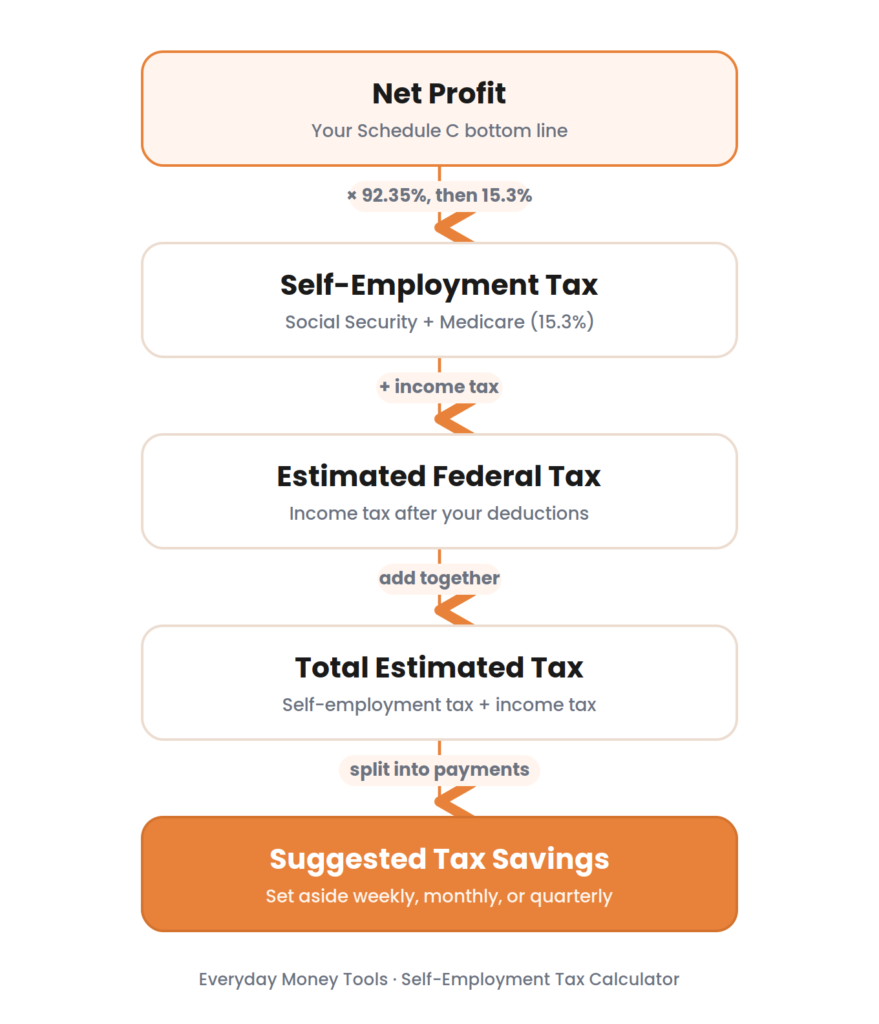
First, it generally multiplies your net profit by 92.35% to determine the portion treated as net earnings from self-employment for this calculation.
Then it applies 12.4% for Social Security, up to the 2026 Social Security wage base of $184,500. If you also have W-2 wages subject to Social Security tax, those wages reduce the amount of your self-employment earnings that can be subject to the Social Security portion of self-employment tax.
It also applies 2.9% for Medicare, which does not have a wage-base limit. A separate 0.9% Additional Medicare Tax may apply when Medicare wages and self-employment income exceed the applicable filing-status threshold: $200,000 for Single, Head of Household, or Qualifying Surviving Spouse; $250,000 for Married Filing Jointly; and $125,000 for Married Filing Separately.
Before estimating federal income tax, the calculator accounts for the deductible portion of self-employment tax. When the QBI option is selected, it also applies a simplified estimate of the Qualified Business Income deduction. Actual QBI eligibility and the amount of the deduction can depend on taxable income, business type, and other IRS rules, so this portion of the calculator should be treated as a planning estimate.
One honest note about QBI: many self-employed taxpayers qualify for the Qualified Business Income (QBI) deduction, although eligibility depends on your taxable income, business type, and other IRS rules. If your income is high or you’re unsure, uncheck the QBI box to see a more conservative number.
Important assumptions: This calculator assumes the standard deduction, no major tax credits, a simplified QBI calculation when selected, and federal taxes only unless you enter a state tax rate. Results are for general planning purposes and are not a filed tax return.
How to Read Your Results
Your results panel gives you the headline suggested savings at the top, and you can switch it between per quarter, per month, per paycheck, or per week because everyone budgets on a different rhythm. Below it, a breakdown separates your estimated self-employment tax, including the Social Security and Medicare portions, from your estimated federal income tax and your estimated total for the year.
Then comes the part I’m proudest of: Your Tax Plan. It’s a short, do-this-next list built from your own numbers. It tells you roughly how much to move into savings and how often, what percentage of each payment that works out to, and your next estimated-tax deadline. A calculator should tell you what to do, not just what you owe.
A Real Example
Say you’re single and earned $50,000 in net profit from freelancing this year, with no other job.
Your net earnings used to calculate self-employment tax are generally 92.35% of $50,000, or about $46,175. The 12.4% Social Security portion is roughly $5,726, and the 2.9% Medicare portion adds about $1,339, resulting in approximately $7,065 in self-employment tax.
Federal income tax is calculated separately. For a simplified planning example, assume the deductible portion of self-employment tax, the 2026 standard deduction, and a simplified QBI deduction all apply. Under those assumptions, estimated taxable income would be about $21,074, producing approximately $2,281 in estimated federal income tax.
Add the estimated self-employment tax and federal income tax together, and the total is approximately $9,346 for the year, or about $2,336 per quarter. That works out to roughly $779 per month if setting money aside monthly is easier.
Your actual tax can differ based on deductions, credits, other income, QBI eligibility, filing circumstances, and other tax rules. This example is for general planning purposes.
Don’t Forget Quarterly Estimated Taxes
Because no employer is withholding taxes for you, the IRS expects you to send in quarterly estimated tax payments four times a year using Form 1040-ES. For the 2026 tax year, the deadlines are:
Q1 — April 15, 2026 · Q2 — June 15, 2026 · Q3 — September 15, 2026 · Q4 — January 15, 2027
Real life isn’t always four equal payments — if you start mid-year, have seasonal income, or land a big fourth-quarter contract, your amounts may differ. Think of the calculator’s number as a suggested savings target, not a fixed bill.
Avoid IRS Underpayment Penalties: The Safe Harbor Rule
Here’s something that saves people real money and almost nobody talks about. Even if you still owe some tax in April, you can usually avoid an underpayment penalty if you paid in enough during the year. The IRS calls this the safe harbor.
Generally, you’re in the clear if your withholding plus estimated payments add up to at least the smaller of:
- 90% of this year’s total tax, or
- 100% of last year’s total tax — or 110% if your prior-year income was over $150,000.
In plain terms: if you simply match what you paid last year (a little more if you’re a higher earner), you’re usually protected from penalties even if this year turns out bigger. Paying those amounts on time, in four installments, is the safest habit a self-employed person can build.
Common Mistakes I Saw at the IRS
Setting nothing aside. The number one reason people panic in April. Every dollar of profit already has a tax partner attached — plan for it from day one.
Confusing gross with net. You owe tax on your profit, not your total sales. If you brought in $80,000 but spent $30,000 on legitimate business expenses, your tax is figured on $50,000. Track those expenses; they directly shrink your bill.
Forgetting the deductible half. You get to deduct half of your self-employment tax when figuring income tax. Plenty of people and plenty of cheap calculators, skip it and overpay. This tool builds it in automatically.
Missing quarterly deadlines. Waiting until April to pay it all at once can trigger a penalty, even when you eventually pay every cent. The IRS wants it as you go.
Assuming an LLC or “business account” changes the tax. It usually doesn’t, unless you’ve made a specific tax election. Don’t let the paperwork fool you into skipping your estimated taxes.
Ways to Legally Lower Your Self-Employment Tax Bill
The number this calculator gives you isn’t fixed in stone. Because self-employment tax is figured on your profit, every legitimate business expense you track lowers the amount the tax applies to. Here are common expenses that may reduce your taxable profit:
| Common business expense | May reduce taxable profit |
|---|---|
| Business mileage | ✅ |
| Office supplies | ✅ |
| Advertising & marketing | ✅ |
| Software subscriptions | ✅ |
| Professional & legal fees | ✅ |
| Business insurance | ✅ |
| Home office (if eligible) | ✅ |
Beyond tracking expenses, two bigger levers are worth knowing:
Open a self-employed retirement account. A SEP-IRA or Solo 401(k) lets you set aside a large chunk of income for retirement and reduce your taxable income. It won’t lower the self-employment tax itself, but it can meaningfully cut the income-tax half of your bill, which is why this calculator has a field for it.
Consider an S-corp election as you grow. Once your profit gets consistently high (many advisors point to somewhere around $80,000+), electing S-corporation status can reduce the self-employment tax on part of your income. It adds payroll and paperwork, so it’s not a starter move, but it’s worth a conversation with a tax pro down the road.
None of these are loopholes. They’re the ordinary, fully legal tools the tax code hands to self-employed people.
A Simple System for Never Missing a Deadline
The freelancers who stay calm at tax time almost always do the same simple thing: they treat tax money as money that was never theirs.
Open a separate savings account just for taxes. Every time you get paid, move the percentage this calculator suggests straight into it (round up to be safe). Don’t wait until the end of the quarter; do it per payment, while the money is in front of you. Then, four times a year, you simply pay the IRS from that account without touching anything else. No scrambling, no April dread, self-employment tax stops being something that happens to you and becomes something you’ve already handled.
The Forms You’ll Actually See
You don’t need to memorize the tax code, but four forms are worth recognizing: Schedule C reports your business profit or loss, Schedule SE calculates your self-employment tax, Form 1040 is your main return that ties it all together, and Form 1040-ES is what you use to make your quarterly estimated payments. This calculator mirrors the Schedule SE math so the self-employment number lines up with what you’ll file.
Your Self-Employment Tax Checklist
Keep this simple routine and tax season stops being scary:
- ✅ Track all business income, from every client and platform.
- ✅ Save a percentage of every payment for taxes, in a separate account.
- ✅ Keep receipts for deductible business expenses.
- ✅ Make your quarterly estimated tax payments on time.
- ✅ Recheck your estimate whenever your income changes.
- ✅ Talk to a tax professional as your business grows or gets more complex.
Frequently Asked Questions
Is self-employment tax the same as income tax?
No. Self-employment tax generally covers Social Security and Medicare taxes and has a combined rate of 15.3%. Federal income tax is calculated separately. This calculator estimates both so you can see a more complete picture of your potential federal tax obligation.
Do I really owe tax on a small side hustle?
If you have $400 or more in net earnings from self-employment, you generally have to pay self-employment tax, even if you owe little or no federal income tax. Small amounts of business income can still create tax obligations.
Do I need to pay quarterly taxes if I also have a W-2 job?
Maybe. If enough tax is withheld from your W-2 paycheck to cover your overall tax obligation, you may not need separate estimated tax payments. If not, estimated payments may still be required. Another option may be to increase withholding from your W-2 wages.
I have an LLC. Do I still pay self-employment tax?
Generally, yes, if you’re the owner of a single-member LLC that is treated as a disregarded entity for federal tax purposes and you have net earnings from a trade or business. Different rules can apply if the LLC elects another federal tax classification, such as S corporation treatment.
What counts as “net profit”?
Generally, it’s your business income minus allowable business expenses. For a sole proprietor, this is generally reflected as the profit or loss reported on Schedule C. It’s not the same as your gross sales or total payments received before expenses.
Why is 92.35% used instead of my full profit?
The Schedule SE calculation generally multiplies net profit by 92.35% to determine net earnings from self-employment before applying the Social Security and Medicare portions of self-employment tax. This calculator follows that basic framework.
Do I qualify for the 20% QBI deduction?
You may. The Qualified Business Income deduction can be up to 20% of qualified business income, but eligibility and the actual deduction can depend on taxable income, business type, and other IRS limitations. This calculator uses a simplified QBI estimate when the option is selected. If you’re unsure whether you qualify, consider comparing the result with the QBI option turned off or consulting a qualified tax professional.
Does this include my state taxes?
Only if you enter a state tax rate in the optional field, and even then it is a rough add-on estimate. State tax rules vary, including rates, deductions, estimated-payment requirements, and filing rules. Check your state’s tax agency for requirements that apply to you.
How accurate is this estimate?
This calculator uses 2026 federal tax figures and a simplified Schedule SE framework to provide a planning estimate. Actual tax results can differ because of credits, deductions, other income, filing circumstances, QBI limitations, Additional Medicare Tax, and other tax rules. Use the result as a planning tool, not as a substitute for a completed tax return or individualized tax advice.
Related Resources
Start here to build the rest of your money picture:
Calculators:
- Paycheck Calculator — see your take-home pay if you also work a W-2 job.
- Budget Calculator — put your set-aside number into a plan that actually holds.
- Savings Goal Calculator — build the tax-savings cushion this page recommends.
- Debt Payoff Calculator — knock out balances with whatever’s left after taxes.
- Rent Affordability Calculator — check how much rent fits your income before taxes eat into your paycheck.
Articles:
- How Much Should You Set Aside for Taxes When You’re Self-Employed? (2026)
- Understanding Your Paycheck Deductions: Where Does Your Money Actually Go?
- The 50/30/20 Budget Rule Explained
Sources & References
Tax rules and thresholds can change. The information and calculator assumptions on this page were reviewed using official IRS guidance for the 2026 tax year. For current rules, forms, and filing instructions, refer directly to the IRS.
- Internal Revenue Service (IRS) — Topic No. 554, Self-Employment Tax
- Internal Revenue Service (IRS) — Publication 505, Tax Withholding and Estimated Tax
- Internal Revenue Service (IRS) — Schedule SE, Self-Employment Tax
- Internal Revenue Service (IRS) — 2026 Social Security and Medicare Tax Rates and Wage Base
- Internal Revenue Service (IRS) — Publications and Forms for the Self-Employed
About Everyday Money Tools
Victoria Hart is the writer behind Everyday Money Tools. She has eight years of experience working at the IRS and three years of experience preparing individual tax returns. Her background, along with her experience managing a household budget, shapes her practical approach to personal finance.
Everyday Money Tools provides free calculators and educational guides designed to make everyday financial topics easier to understand. The tools are intended to help readers estimate, organize, and better understand their finances so they can make decisions based on their own circumstances.
Everyday Money Tools provides general educational information and calculator estimates, not individualized financial, tax, legal, or investment advice.