

Self-Employment Tax Calculator and Quarterly Tax Estimate
Estimate your federal self-employment tax and create a personalized quarterly tax savings target based on the information you enter.
Self-Employment & Quarterly Tax Calculator
Estimate your 2026 self-employment tax and how much to set aside for taxes. Follows the IRS Schedule SE methodology.
Your business income after expenses — the bottom line from Schedule C, not your gross sales.
Income already having taxes withheld. Helps place your business income in the right bracket.
Lowers your taxable income — one of the few levers that reduces the income-tax half.
A rough add-on for your state. Leave blank if your state has no income tax or you're not sure.
Suggested savings
$0
Enter your profit to see your numbers.
This calculator provides a 2026 federal tax estimate for educational and planning purposes only, not tax advice. Estimates are based on IRS Schedule SE rules, the standard deduction, and—when enabled, a simplified 20% Qualified Business Income (QBI) deduction. Results do not account for every tax situation, including tax credits, itemized deductions, alternative minimum tax, or state-specific rules. The Additional Medicare Tax (0.9%) is estimated separately for earnings above the applicable IRS threshold. State tax estimates are approximate. Always consult a qualified tax professional or refer to IRS Form 1040-ES and Schedule SE for your official tax obligations.
By Victoria Hart · Published June 30 · Updated October 22 · Reading time: 17 min
Estimate What to Set Aside for Self-Employment Taxes
This self-employment tax calculator can help you estimate how much you may need to set aside for federal self-employment tax and income tax. Enter your net self-employment profit, choose your filing status, and review the estimated amounts based on the information you provide.
Self-employed individuals may owe both self-employment tax and federal income tax, depending on their income and tax situation. Planning ahead can make it easier to set money aside during the year and prepare for quarterly estimated tax payments or your annual tax return.
What Is Self-Employment Tax, Really?
When you work as an employee, Social Security and Medicare taxes are generally shared between you and your employer. Employees typically have 6.2% withheld for Social Security and 1.45% for Medicare, while employers generally pay matching amounts.
When you work for yourself, you generally pay self-employment tax to cover both the Social Security and Medicare portions. The standard self-employment tax rate is 15.3%, consisting of 12.4% for Social Security and 2.9% for Medicare. In general, self-employment tax is calculated on 92.35% of net earnings from self-employment. Social Security tax is subject to an annual wage base, and additional Medicare tax may apply at higher income levels.
Self-employment tax is separate from federal income tax. Depending on your income, deductions, credits, filing status, and other circumstances, you may owe both. Understanding the difference can help you plan for taxes throughout the year.
💡 Quick Tip: Consider setting aside money for taxes as you receive self-employment income. The amount you may need depends on your net profit, other income, filing status, deductions, credits, and individual tax situation. Use the calculator as a planning estimate rather than a guarantee of your final tax bill.
W-2 or 1099? Knowing Which One You Are
Whether you are an employee or an independent contractor affects how taxes are reported and paid. The tax form you receive can provide a useful clue, but the form alone does not determine your worker classification. The IRS also considers factors such as behavioral control, financial control, and the relationship between you and the person or business paying you.
| If You Receive… | It Generally Reports… |
|---|---|
| W-2 | Wages paid to an employee, with payroll taxes generally withheld by the employer. |
| 1099-NEC | Nonemployee compensation that may be connected with independent contractor or self-employment income. |
| 1099-K | Certain payments processed through payment cards or third-party settlement organizations. |
| 1099-MISC | Certain other reportable payments, such as rents, royalties, and some other types of income. |
Receiving a 1099-NEC can be a sign that the income may be treated as nonemployee compensation, but worker classification depends on the facts and circumstances of the working relationship. Some people also have both W-2 wages and self-employment income. If that applies to you, the calculator may allow you to include other income so you can create a broader planning estimate.
Who Has to Pay It?
If you have $400 or more in net earnings from self-employment during the year, you generally must file Schedule SE and may owe self-employment tax. This can apply to freelancers, consultants, gig workers, independent contractors, real estate agents, and people earning profit from a side business.
Because the filing threshold is relatively low, even a smaller amount of self-employment income can create a tax filing requirement. Keeping records of your business income and deductible expenses throughout the year can make tax planning and filing easier.
What if I have an LLC? A single-member LLC that has not elected corporate tax treatment is generally treated as a disregarded entity for federal income tax purposes. In that situation, the business activity is typically reported on the owner’s federal tax return, and net earnings may be subject to self-employment tax. Different rules can apply if the LLC elects to be taxed as a corporation or S corporation.
How This Calculator Works
The calculator uses the basic Schedule SE framework and 2026 federal tax figures to provide a planning estimate.
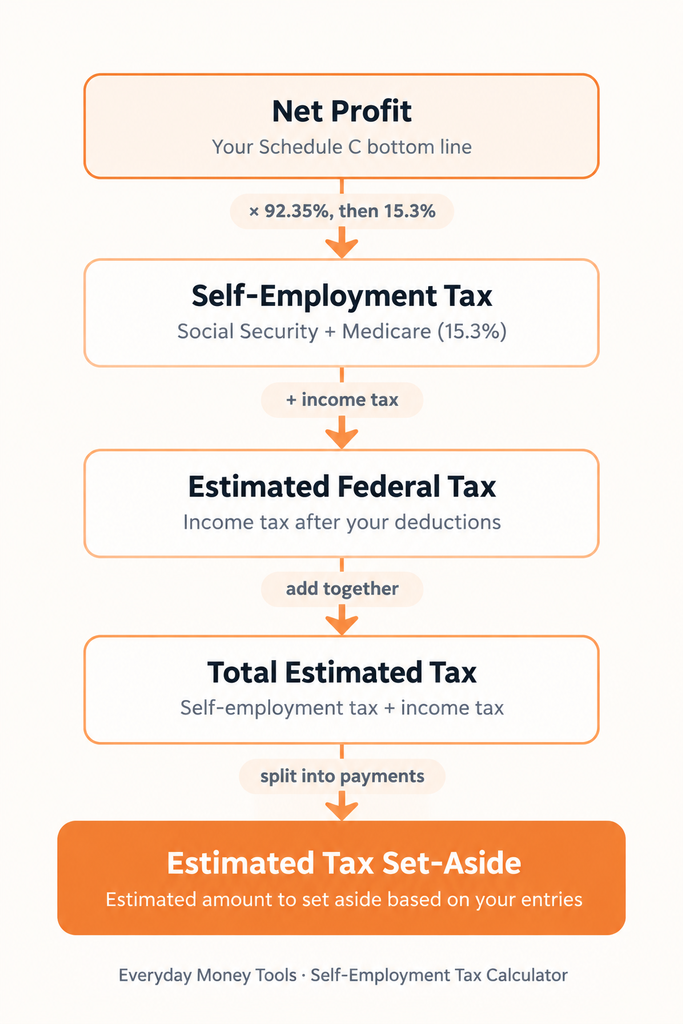
First, it generally multiplies your net profit by 92.35% to estimate the portion treated as net earnings from self-employment for purposes of the self-employment tax calculation.
It then applies the 12.4% Social Security tax rate, subject to the 2026 Social Security wage base of $184,500. If you also have W-2 wages subject to Social Security tax, those wages can reduce the amount of your self-employment earnings that is subject to the Social Security portion of self-employment tax.
The calculator also applies the 2.9% Medicare tax, which does not have a wage-base limit. A separate 0.9% Additional Medicare Tax may apply when combined Medicare wages and self-employment income exceed the applicable filing-status threshold: $200,000 for Single, Head of Household, or Qualifying Surviving Spouse; $250,000 for Married Filing Jointly; and $125,000 for Married Filing Separately.
Before estimating federal income tax, the calculator accounts for the deductible portion of self-employment tax. If the QBI option is selected, it also applies a simplified estimate of the Qualified Business Income deduction. Actual QBI eligibility and the amount of the deduction can depend on taxable income, business type, and other IRS rules, so this part of the calculator should be treated as a planning estimate.
Important Note About QBI: Many self-employed taxpayers may qualify for the Qualified Business Income (QBI) deduction, but eligibility and the amount of the deduction depend on taxable income, business type, and other IRS rules. If you are unsure whether QBI applies to your situation, compare the estimate with and without the QBI option.
Important assumptions: This calculator assumes the standard deduction, no major tax credits, a simplified QBI calculation when selected, and federal taxes only unless you enter a state tax rate. Results are for general planning purposes and are not a filed tax return.
How to Read Your Results
Your results panel gives you the headline suggested savings at the top, and you can switch it between per quarter, per month, per paycheck, or per week because everyone budgets on a different rhythm. Below it, a breakdown separates your estimated self-employment tax, including the Social Security and Medicare portions, from your estimated federal income tax and your estimated total for the year.
Then comes the part I’m proudest of: Your Tax Plan. It’s a short, do-this-next list built from your own numbers. It tells you roughly how much to move into savings and how often, what percentage of each payment that works out to, and your next estimated-tax deadline. A calculator should tell you what to do, not just what you owe.
A Real Example
Suppose you are single and have $50,000 in net profit from self-employment for the year, with no other income.
For this example, the net earnings used to calculate self-employment tax are generally 92.35% of $50,000, or about $46,175. The 12.4% Social Security portion is approximately $5,726, and the 2.9% Medicare portion is approximately $1,339, resulting in about $7,065 in estimated self-employment tax.
Federal income tax is estimated separately. For this simplified 2026 planning example, assume the deductible portion of self-employment tax, the standard deduction for a single filer, and a qualified business income (QBI) deduction apply. The QBI deduction is limited to 20% of taxable income before the QBI deduction, excluding net capital gain. Under these assumptions, estimated taxable income would be about $24,294, resulting in approximately $2,667 in estimated federal income tax.
How the Estimated Taxable Income is Calculated:
- Annual net profit: $50,000
- Deductible half of self-employment tax: $3,532
- Adjusted gross income: $46,468
- 2026 standard deduction (single filer): $16,100
- Taxable income before the QBI deduction: $30,368
- Estimated QBI deduction (limited to 20% of taxable income before QBI): $6,074
- Estimated taxable income after the QBI deduction: $24,294
Combining the estimated self-employment tax and federal income tax gives an estimated total of about $9,732 for the year, or approximately $2,433 per quarter. If you prefer to set money aside monthly, that is about $811 per month.
Your actual tax liability may differ based on deductions, credits, other income, QBI eligibility, filing circumstances, and other tax rules. This example is for general planning purposes.
Don’t Forget Quarterly Estimated Taxes
If you have self-employment income, you may need to make federal estimated tax payments using Form 1040-ES. Generally, estimated payments may be required if you expect to owe at least $1,000 in federal tax for the year after subtracting withholding and refundable credits, and your payments or withholding do not meet IRS safe-harbor requirements. Estimated payments can cover both federal income tax and self-employment tax. Special rules and exceptions may apply.
For the 2026 tax year, the regular estimated tax payment due dates are:
Q1 — April 15, 2026 · Q2 — June 15, 2026 · Q3 — September 15, 2026 · Q4 — January 15, 2027
Your payments do not always have to be equal. If your income changes during the year, such as when income is seasonal or begins later in the year, your estimated payment amounts may also change. Use the calculator’s result as a planning estimate rather than a fixed tax bill.
Avoid IRS Underpayment Penalties: The Safe Harbor Rule
Federal income taxes generally operate on a pay-as-you-go system. If you do not have enough tax withheld during the year, you may need to make estimated tax payments. The IRS safe harbor rules can help determine how much generally needs to be paid during the year to reduce the risk of an underpayment penalty.
In general, you may avoid a federal underpayment penalty if your timely withholding and estimated tax payments equal at least the smaller of:
- 90% of the tax shown on your current-year return, or
- 100% of the tax shown on your prior-year return, provided that return covered a full 12-month tax year.
For certain higher-income taxpayers, the prior-year safe harbor generally increases to 110% of the prior-year tax. This generally applies when prior-year adjusted gross income was more than $150,000, or more than $75,000 if Married Filing Separately.
Timing also matters. Estimated tax payments generally need to be made by the applicable due dates during the year. Different rules and exceptions can apply, including for people with uneven or seasonal income and certain taxpayers who had no prior-year tax liability.
Use the calculator as a planning tool, and compare your situation with current IRS guidance when determining whether estimated payments are required and how much to pay.
Common Mistakes I Saw at the IRS
Setting nothing aside. Self-employment income may create federal income tax and self-employment tax obligations. Setting aside money as you earn can make it easier to prepare for estimated payments or your annual tax return.
Confusing gross income with net profit. Self-employment tax is generally based on net earnings from self-employment, not simply total sales or revenue. Tracking allowable business expenses can help you understand your actual profit and improve the accuracy of your tax estimate.
Forgetting the deductible portion of self-employment tax. When figuring federal income tax, you may generally deduct the employer-equivalent portion of self-employment tax. This calculator includes that adjustment in its planning estimate.
Missing estimated tax deadlines. Waiting until you file your annual return can increase the risk of an underpayment penalty if enough tax was not paid during the year. Estimated payments may be required depending on your situation.
Assuming an LLC automatically changes your federal tax treatment. Forming an LLC does not by itself determine how the business is taxed for federal purposes. Tax treatment depends on the type of entity and any tax elections that apply.
Ways to Potentially Reduce Your Self-Employment Tax Bill
Self-employment tax is generally based on net earnings from self-employment. Legitimate business expenses that are ordinary and necessary for your business may reduce your net profit, which can also affect the amount of self-employment tax you owe. Eligibility for a deduction depends on the expense and your individual circumstances.
| Common Business Expense | Potential Tax Treatment |
|---|---|
| Business mileage | May be deductible if eligible |
| Office supplies | May be deductible if business-related |
| Advertising and marketing | May be deductible if business-related |
| Software subscriptions | May be deductible if used for business |
| Professional and legal fees | May be deductible when related to the business |
| Business insurance | May be deductible if business-related |
| Home office | May qualify if IRS requirements are met |
Beyond business expenses, other tax-planning strategies may also affect your overall federal tax bill.
Consider a self-employed retirement plan. A SEP IRA, Solo 401(k), or other eligible retirement plan may allow you to make deductible contributions and reduce federal taxable income. These contributions generally do not reduce self-employment tax itself, so their primary tax effect may be on federal income tax.
Understand how an S corporation election works. An eligible business may elect S corporation tax treatment, but this does not automatically reduce taxes. An owner who performs services for the corporation generally must receive reasonable compensation subject to payroll taxes. Whether an S corporation election makes sense depends on profit, payroll costs, administrative requirements, state taxes, and other factors.
These strategies are subject to specific IRS rules and eligibility requirements. Consider your full tax situation before making business-structure or retirement-plan decisions.
A Simple System for Never Missing a Deadline
One way to make self-employment taxes easier to manage is to set money aside regularly instead of waiting until a payment deadline approaches.
Consider keeping tax money in a separate savings account. Each time you receive self-employment income, you can move part of it into that account based on your estimated tax set-aside amount. The percentage you use may change as your income, deductions, credits, and tax situation change.
Setting money aside throughout the year can make it easier to prepare for estimated tax payments and your annual tax return. Review your estimates periodically, especially if your income changes significantly during the year.
Add the estimated tax payment due dates to your calendar and set reminders a week or two in advance. Before each deadline, review your income and estimated tax payments to determine whether your planned payment amount needs adjusting.
The Forms You’ll Actually See
You do not need to memorize the tax code, but a few common federal tax forms are useful to recognize. Schedule C is generally used to report profit or loss from a sole proprietorship. Schedule SE is used to calculate self-employment tax. Form 1040 is the individual federal income tax return, and Form 1040-ES is used to help calculate and make estimated tax payments. This calculator uses a simplified version of some of these concepts to provide a planning estimate.
Your Self-Employment Tax Checklist
A simple routine can make self-employment tax planning easier to manage throughout the year:
- ✅ Track business income from clients, platforms, and other sources.
- ✅ Keep records of deductible business expenses.
- ✅ Set aside money for taxes based on your current estimate.
- ✅ Review whether quarterly estimated tax payments may be required.
- ✅ Recalculate your estimate when income or expenses change significantly.
- ✅ Consider professional tax guidance as your business grows or your tax situation becomes more complex.
Frequently Asked Questions
Is self-employment tax the same as income tax?
No. Self-employment tax generally covers Social Security and Medicare taxes and has a combined rate of 15.3%. Federal income tax is calculated separately. This calculator estimates both so you can see a more complete picture of your potential federal tax obligation.
Do I really owe tax on a small side hustle?
If you have $400 or more in net earnings from self-employment, you generally have to pay self-employment tax, even if you owe little or no federal income tax. Small amounts of business income can still create tax obligations.
Do I need to pay quarterly taxes if I also have a W-2 job?
Maybe. If enough tax is withheld from your W-2 paycheck to cover your overall tax obligation, you may not need separate estimated tax payments. If not, estimated payments may still be required. Another option may be to increase withholding from your W-2 wages.
I have an LLC. Do I still pay self-employment tax?
Generally, yes, if you’re the owner of a single-member LLC that is treated as a disregarded entity for federal tax purposes and you have net earnings from a trade or business. Different rules can apply if the LLC elects another federal tax classification, such as S corporation treatment.
What counts as “net profit”?
Generally, it’s your business income minus allowable business expenses. For a sole proprietor, this is generally reflected as the profit or loss reported on Schedule C. It’s not the same as your gross sales or total payments received before expenses.
Why is 92.35% used instead of my full profit?
The Schedule SE calculation generally multiplies net profit by 92.35% to determine net earnings from self-employment before applying the Social Security and Medicare portions of self-employment tax. This calculator follows that basic framework.
Do I qualify for the 20% QBI deduction?
You may. The Qualified Business Income deduction can be up to 20% of qualified business income, but eligibility and the actual deduction can depend on taxable income, business type, and other IRS limitations. This calculator uses a simplified QBI estimate when the option is selected. If you’re unsure whether you qualify, consider comparing the result with the QBI option turned off or consulting a qualified tax professional.
Does this include my state taxes?
Only if you enter a state tax rate in the optional field, and even then it is a rough add-on estimate. State tax rules vary, including rates, deductions, estimated-payment requirements, and filing rules. Check your state’s tax agency for requirements that apply to you.
How accurate is this estimate?
This calculator uses 2026 federal tax figures and a simplified Schedule SE framework to provide a planning estimate. Actual tax results can differ because of credits, deductions, other income, filing circumstances, QBI limitations, Additional Medicare Tax, and other tax rules. Use the result as a planning tool, not as a substitute for a completed tax return or individualized tax advice.
Related Resources
Calculators:
- Paycheck Calculator: Estimate your take-home pay if you also receive W-2 wages.
- Monthly Budget Calculator: Add your estimated tax set-aside to your monthly budget.
- Savings Goal Calculator: Create a savings target for taxes or another financial goal.
- Debt Payoff Calculator: Compare debt payoff strategies and see how monthly payments may affect your budget.
- Rent Affordability Calculator: Estimate how rent may fit within your income and other monthly obligations.
Articles:
- How Much Should You Set Aside for Taxes When You’re Self-Employed? (2026)
- Understanding Your Paycheck Deductions: Where Does Your Money Actually Go?
- The 50/30/20 Budget Rule Explained
Sources & References
Tax rules and thresholds can change. The information and calculator assumptions on this page were reviewed using official IRS guidance for the 2026 tax year. For current rules, forms, and filing instructions, refer directly to the IRS.
- Internal Revenue Service (IRS): Topic No. 554, Self-Employment Tax
- Internal Revenue Service (IRS): Publication 505, Tax Withholding and Estimated Tax
- Internal Revenue Service (IRS): Schedule SE, Self-Employment Tax
- Internal Revenue Service (IRS): 2026 Social Security and Medicare Tax Rates and Wage Base
- Internal Revenue Service (IRS): Publications and Forms for the Self-Employed
About Everyday Money Tools
Victoria Hart is the writer behind Everyday Money Tools. She has eight years of experience working at the IRS and three years of experience preparing individual tax returns. Her background, along with her experience managing a household budget, shapes her practical approach to personal finance.
Everyday Money Tools provides free calculators and educational guides designed to make everyday financial topics easier to understand. The tools are intended to help readers estimate, organize, and better understand their finances so they can make decisions based on their own circumstances.
Everyday Money Tools provides general educational information and calculator estimates, not individualized financial, tax, legal, or investment advice.